

Asset-Backed Product Design Template: A Case Model for RWAs (Unit, Custody, Reporting, Exit)
Before we debate blockchain choices, we often need one page that makes an RWA investable and operable. What exactly is the unit? Who holds the underlying asset and under which process? What gets reported, and what triggers disclosure? And how do holders exit?
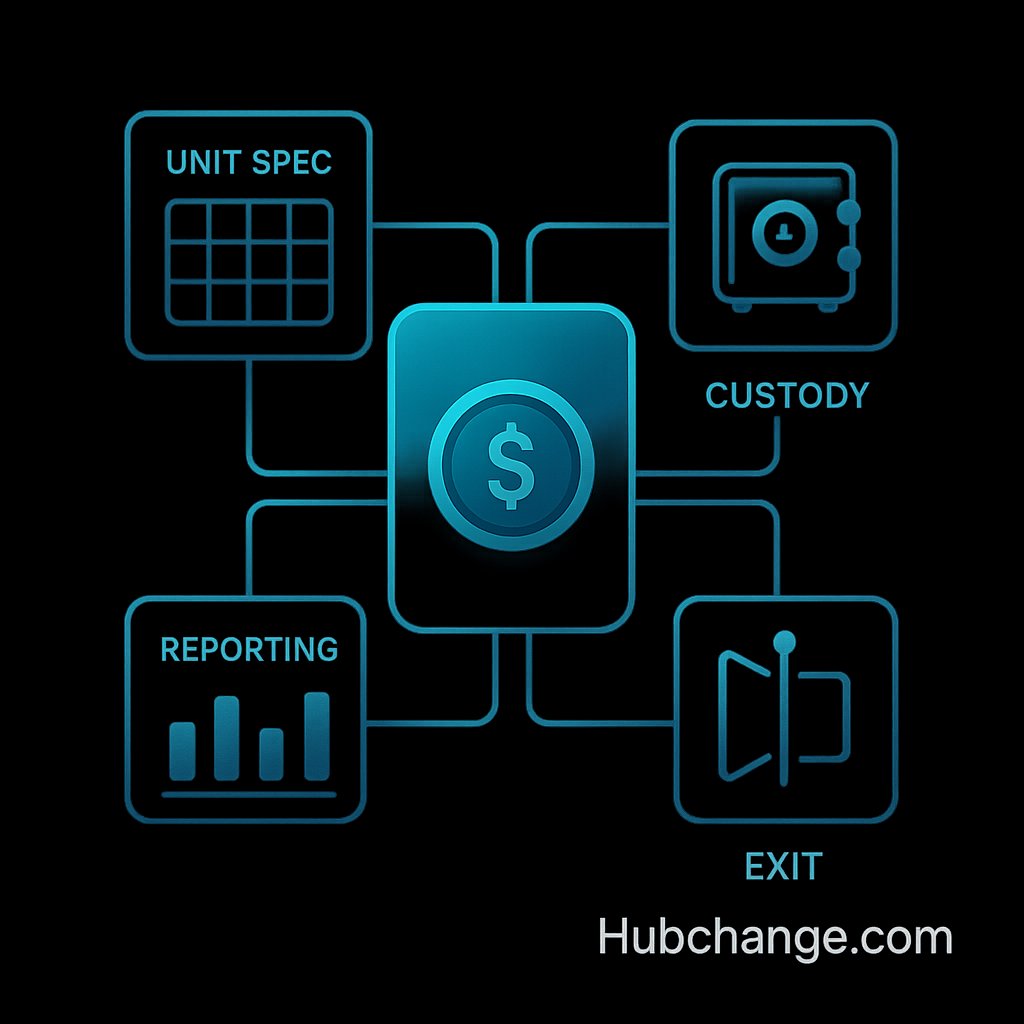

Before we debate blockchain choices, we often need one page that makes an RWA investable and operable. What exactly is the unit? Who holds the underlying asset and under which process? What gets reported, and what triggers disclosure? And how do holders exit?
Introduction
RWA (real-world asset) tokenization can make ownership and transfers more transparent, traceable, and programmable. Its strongest results come when we design the product operations alongside the technology.
This article provides an asset-backed product design template—a reusable “Case Design” model that finance, legal, operations, and product teams can fill in before writing code or starting distribution. The goal is a one-page spec that aligns the organization on the unit, custody, reporting, controls, and exit.
The problem
Many teams reach “token issued” and then discover they do not actually have a product:
- Operations cannot reconcile what should exist versus what is issued.
- Legal documents describe ownership in general terms, but not the practical promise.
- Reporting is either too vague to build trust or too heavy to run repeatedly.
- When an anomaly happens (quality issue, delayed delivery, market suspension), nobody knows who can pause what.
- Exit and redemption are spoken about as “liquidity,” not as a testable rule.
In RWA, market trust usually follows product engineering discipline more than technology novelty.
The 5 building blocks of a strong asset-backed unit
A good asset-backed unit behaves like a financial product: the market can understand it, audit it, operate it, and exit it.
1) The unit: what exactly is being sold?
We need a unit specification written as if it may be audited and disputed:
- Unit definition: what 1 unit represents (quantity, grade/standard, location constraints).
- Eligibility rules: what assets can enter the backing pool and what cannot.
- Valuation basis: how we define “value” for reporting (price source policy, valuation timing, frequency).
- Corporate actions / asset events: what happens if the asset changes form (e.g., splitting lots, re-grading, repair).
Clarity here prevents “token drift,” where the issued units slowly stop matching a consistent underlying standard.
2) Custody: an operating process, not a checkbox
Custody is not only “where the asset sits.” It is a repeatable process with explicit responsibilities:
- Custodian role and segregation: how assets are segregated and identified.
- Chain of control: who can move, inspect, or reclassify assets.
- Permitted actions: storage, maintenance, insurance, audit access.
- Exception handling: what happens if an asset is damaged, missing, or fails an inspection.
Tokenization can increase traceability of these actions, but the operating playbook must exist first.
3) Reporting: periodic + event-driven disclosures
Reporting should be designed as two streams:
- Periodic reporting: inventory statement, reconciliation, valuation summary, key KPIs.
- Event-driven reporting: disclosures triggered by defined events (custody transfer, inspection failures, legal claims, material valuation method changes).
A practical rule is to define reporting so that a third party could reconstruct “what happened” without informal explanations.
4) Controls: suspension, limits, and exception governance
Markets dislike improvisation during anomalies. A robust case model defines controls upfront:
- Suspension rules: under which conditions issuance, transfers, or redemptions may be paused.
- Limits: concentration limits, issuance caps, haircut policies, or buffers (when relevant).
- Decision rights: who declares an exception and who confirms recovery.
- Audit and logs: what evidence is kept and for how long.
This is not pessimism. It is the operational equivalent of circuit breakers in mature markets.
5) Exit and redemption: the product promise
Exit is not a marketing line; it is a contract-like promise with testable steps:
- Exit types: physical delivery, cash redemption, secondary transfer, or scheduled windows.
- Timelines: notice periods, settlement cycle, cut-off times.
- Fees and deductions: storage, delivery, verification, taxes (described as categories, not quotes).
- Failure modes: what happens if redemption cannot proceed (e.g., force majeure, custody disputes).
If we cannot write this cleanly, we do not yet have an investable unit.
A practical framework: the fill-in-the-blanks Case Design template
Below is a one-page structure teams can reuse for any asset. It is intentionally short, but each line forces alignment.
Case Design (one page)
A) Product goal and users
- Goal of the unit (hedging, access, collateralization, settlement utility): …
- Target users and restrictions (professional vs. retail, geography, eligibility): …
B) Underlying asset and unit specification
- Asset type and standard/grade: …
- Unit size (1 unit = …): …
- Eligibility and exclusion rules: …
- Valuation policy (reference sources, timing, frequency): …
C) Issuance and reconciliation
- Issuance conditions (what must be true before mint/issue): …
- Reconciliation method (how we prove backing continuously): …
- Maximum issuance logic (caps, buffers, overcollateralization if any): …
D) Custody and asset operations
- Custody model (segregation, identification): …
- Permitted actions and approvals: …
- Inspection/audit schedule and evidence retained: …
- Exception process (damage, loss, failed inspection): …
E) Reporting and disclosures
- Periodic report package (what, how often, format): …
- Event triggers (what changes force disclosure): …
- Data ownership and sign-off (who certifies which fields): …
F) Controls and governance
- Suspension conditions and scope (issue/transfer/redeem): …
- Decision rights and escalation path: …
- Incident response timeline and public communication rule: …
G) Exit and redemption
- Exit routes and eligibility: …
- Settlement timeline and cut-offs: …
- Fees and operational steps: …
- Failure modes and fallback process: …
H) KPIs (to run the product)
- Operational KPIs (reconciliation breaks, time-to-redeem, exception rate): …
- Risk KPIs (concentration, custody incidents, valuation deviations): …
A simple example (hypothetical)
Assume we want an asset-backed unit tied to an underlying commodity stored in approved warehouses.
- The unit could be defined as a fixed weight with a stated purity/standard and a clear warehouse eligibility list.
- The custody process would specify segregation, inspection cadence, and what happens if a batch fails quality checks.
- Reporting would include periodic inventory + reconciliation, and event-driven disclosure for custody transfers or inspection failures.
- Controls would include pre-defined suspension rules if warehouse access is disrupted or reconciliation breaks exceed a threshold.
- Exit would specify whether holders redeem through delivery, cash redemption, or transfer, with settlement timelines and cut-offs.
This is also how we can understand maturity in conventional markets: one underlying asset can support layered instruments over time when the base unit is well defined and operable. In Iran, a market recap about silver trading highlighted activity distributed across instrument layers such as funds, deposit receipts, and options—illustrating how structure builds on a trusted base unit (not as tokenization itself, but as an analogy for layering around an underlying asset). Source: https://armaneghtesadi.com/974914/1405/06/18/%D8%A7%D8%B1%D8%B2%D8%B4-%D9%85%D8%B9%D8%A7%D9%85%D9%84%D8%A7%D8%AA-%D9%86%D9%82%D8%B1%D9%87-%D8%A7%D8%B2-%D9%85%D8%B1%D8%B2-%DB%B3%DB%B2%DB%B0%DB%B0-%D9%85%DB%8C%D9%84%DB%8C%D8%A7%D8%B1%D8%AF-%D8%AA/?amp=1&utm_source=openai
Implementation considerations (who owns each control?)
A case model becomes executable when ownership is explicit:
- Finance/capital markets: unit economics, valuation policy, KPI targets.
- Operations: custody workflow, reconciliation, exception handling.
- Legal/compliance: rights, restrictions, disclosures, dispute process.
- Technology: token lifecycle, access control, audit logs, reporting automation.
Tokenization helps when these roles agree on the data and decision points the system must enforce.
Risks and limitations
Templates do not guarantee market success. They help us avoid preventable failures:
- Unclear exit: redemption rules that depend on ad-hoc decisions undermine trust.
- Weak reporting: if reports cannot be verified or are too infrequent, the unit trades on rumor.
- Quality drift: vague eligibility rules cause the backing pool to degrade over time.
- Control ambiguity: without suspension and escalation rules, incidents become reputational crises.
The stronger execution comes from combining the template with legal documentation, custody agreements, identity/access controls, and repeatable audit evidence.
Conclusion
RWA success is mostly product engineering. When we define the unit, custody process, reporting, controls, and exit in a one-page case model, we create something the market can operate repeatedly.
Once the case is clear, technology choices become easier: tokenization can amplify transparency and programmability because the underlying promise is already precise.
FAQ
1) Is a token the product?
Not by itself. The product is the full promise: unit definition, custody process, reporting, controls, and exit.
2) How detailed should reporting be at the start?
Detailed enough that reconciliation and key events can be reconstructed. We can expand reports over time, but we should not start with unverifiable summaries.
3) Why define suspension rules upfront?
Because anomalies happen in real operations. Pre-defined rules keep decisions consistent and reduce chaos when an exception occurs.