

RWAs for Industrial Supply Chains: How to Standardize “Goods-in-Transit” as Financeable Units
If we can’t consistently record where a shipment is and who benefits from it, we can’t finance it reliably. “Goods in transit” sits between warehouses, customs, and carriers—and that gray zone is where working capital gets stuck.
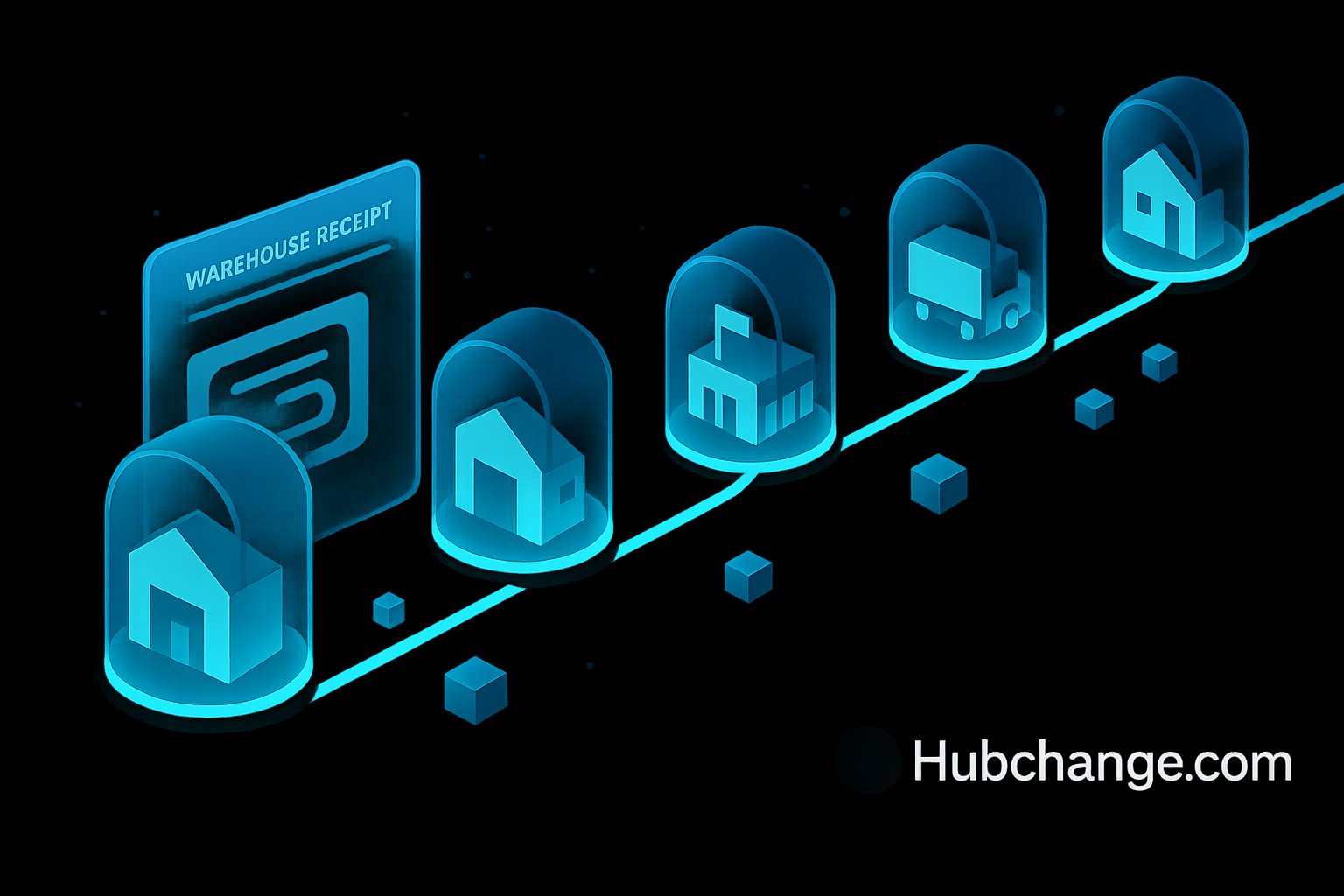

If we can’t consistently record where a shipment is and who benefits from it, we can’t finance it reliably. “Goods in transit” sits between warehouses, customs, and carriers—and that gray zone is where working capital gets stuck. RWAs (real-world assets) become practical only when we can describe the moving commodity as a stable, queryable unit.
Introduction
In industrial supply chains, tokenization is often discussed as if the token is the starting point. In practice, RWA readiness begins earlier: with verifiable events and identifiers that match real workflows.
In this article, we build a simple event-based model for “goods in transit” and list the minimum data fields that should remain stable and queryable. The goal is operational: to create a record that can later support financing or fractional trading with fewer disputes—not to promise that financing will automatically be available.
The problem
A shipment can be real and valuable, yet hard to finance while it is moving. The reasons are rarely “technology.” They are usually basic questions that different parties answer differently:
- Is the unit defined the same way in procurement, warehouse, transport, and customs records?
- Is there a single timeline that explains custody and status changes?
- Can we prove that the same goods were not pledged twice under different references?
When these questions are unresolved, a financier sees ambiguity. Ambiguity translates into higher haircuts, extra documentation, slower approvals, or a complete “no.”
The core idea: represent the asset in events, not documents
A document (invoice, packing list, receipt) is important, but it often captures a snapshot. “Goods in transit” needs a movie: a sequence of events.
An event-based representation means we treat the shipment as a unit whose state changes over time. Each state change is recorded as a standardized event with a timestamp, location, actor role, and references.
This is also where “RWA thinking” becomes concrete: the asset is not just a commodity description; it is a commodity plus its verified lifecycle.
Minimum data fields that must be stable and queryable
To make a moving commodity financeable later, we need a dataset small enough to be implemented consistently—yet complete enough to prevent disputes.
A practical minimum set usually includes:
- Goods identifier (stable unit ID): an internal shipment ID, lot/batch ID, or other stable identifier that ties all events together.
- Commodity description: SKU/product name, grade/specification if relevant.
- Quantity and unit of measure: plus tolerance rules if partial delivery is allowed.
- Packaging/traceability hints (when needed): batch/serial, container number, seal number, pallet count.
- Beneficial owner / beneficiary: who economically benefits at each point (not only who physically holds it).
- Custodian role: warehouse operator, carrier, customs hold, etc. (role-based is often more robust than naming individuals).
- Time and location for every event: timestamps and standardized location identifiers.
- Anchor references: warehouse receipt reference, customs reference, transport document reference, purchase/sales order references.
The key is consistency: if we cannot query the same identifiers across systems, we can’t reconcile the timeline.
The 6 key events for goods-in-transit
We can keep the model simple and still cover most industrial flows by standardizing six events. Each event should update the same shipment record, not create a separate “parallel truth.”
- Warehouse In (receipt into warehouse)
- Establishes initial custody, quantity, and condition.
- Warehouse Out (release from warehouse)
- Marks the start of “in transit” exposure and often triggers the first financing conversation.
- Transport handoff (carrier takes custody)
- Records who physically holds the goods and under what reference.
- Customs release / customs status change (when applicable)
- Separates “moving” from “legally cleared,” which matters for risk and timing.
- Ownership or beneficiary change
- Captures economic rights changes (sale, pledge, assignment of proceeds). Even when legal ownership transfer requires other instruments, recording the event helps align operations and finance.
- Delivery confirmation / final receipt
- Confirms arrival, accepted quantity, and closes the in-transit lifecycle.
This sequence is not about adding bureaucracy. It is about giving everyone the same map.
Where warehouse receipts and unique identifiers fit (data rails, not tokenization)
In Iran, mandated reporting rails exist around inventory and warehouse records, including warehouse receipts and a unique identifier for receipts in the context of national systems. One practical advantage is that such identifiers can serve as an anchor reference inside our event log.
According to executive regulations related to national trade and warehouse systems, there is an obligation to send inventory and warehouse receipt information and obtain a “unique identifier” for warehouse receipts within those frameworks. (Source: law-ir.ir category page hosting relevant regulations; public entities include سامانه جامع تجارت and سامانه جامع انبارها.)
Operationally, we can treat the warehouse receipt unique ID as:
- a verifiable pointer to a custody/status milestone,
- a reconciliation key between warehouse operations and finance,
- an anti-duplication control when combined with our shipment unit ID.
This does not automatically mean we are tokenizing anything. It means we are using existing data rails to make the asset lifecycle easier to verify.
A practical framework: building a “goods-in-transit registry card”
A simple way to implement the model is to create a single “registry card” per shipment unit:
- Header (static fields): unit ID, commodity spec, planned quantity, packaging hints, counterparties, expected route.
- Timeline (events): each of the 6 events recorded in the same format: time, location, role, quantity confirmed, reference IDs, and notes.
- Controls: who can write events, who can approve corrections, and how discrepancies are flagged.
If we later choose to tokenize, this registry card becomes the factual backbone that a token can point to. Without it, a token is just a label.
A simple example (hypothetical)
Imagine a manufacturer ships 22 tons of a metal input from a warehouse in one province to a project site in another, with customs clearance involved for a portion of the route.
- The unit ID is created at Warehouse Out.
- The carrier handoff event records truck details and the transport reference.
- Customs status is recorded as an event with timestamp and reference.
- A beneficiary change event records that proceeds are assigned to a financing arrangement (as an operational note plus reference).
- Final delivery confirmation records accepted quantity (e.g., 21.8 tons due to standard tolerance) and closes the unit.
Now, if finance asks “what exactly is being financed,” we can answer with a single queryable timeline rather than a stack of PDFs.
Risks and limitations (implementation considerations)
An event model improves clarity, but stronger execution depends on complementary layers:
- Data responsibility: We need clear ownership for who writes which events (warehouse, logistics, procurement, finance) and how corrections are governed.
- Reconciliation rules: Partial deliveries, damage, and re-packaging must have predefined handling so the unit doesn’t “split into myths.”
- Dispute prevention: Each event should carry references and basic evidence pointers; otherwise, the timeline can become contested.
- Legal/contract alignment: Beneficiary and ownership events should be aligned with the company’s contracts and formal documentation processes.
These are not blockers; they are the operational conditions that make later RWA/tokenization implementations credible.
Conclusion
In supply chains, RWA readiness starts with a standardized event log and queryable identifiers—tokens come later. When we define “goods in transit” as a unit that moves through a small set of repeatable events, we reduce ambiguity and create records that financiers can evaluate with less friction.
If we want tokenization to be more than a concept, our first step is simple: make the shipment lifecycle legible, consistent, and auditable through events, timestamps, locations, and stable IDs.
FAQ
1) Is a warehouse receipt the same as tokenization?
No. A warehouse receipt is a conventional operational/legal document. It can act as a strong data anchor for an event log, which later helps tokenization, but it is not tokenization by itself.
2) Do we need blockchain to start?
Not necessarily. We can start with standardized event records in existing systems. Blockchain becomes useful when we want shared verification, tamper-evidence, and programmable rules across parties.
3) What is the single biggest mistake in goods-in-transit tracking?
Treating each document as a separate truth. When events are not tied to one stable unit ID, reconciliation becomes manual and disputes become likely.